Maximizing Wealth with Private Placement Life Insurance: A Comparison to Taxable Accounts
Rajiv Rebello
Author
February 11, 2025

When it comes to optimizing investment strategies, one of the most powerful vehicles that ultra-high-net-worth (UHNW) individuals often use is a Private Placement Life Insurance (PPLI) policy. While many investors are familiar with taxable accounts, the world of PPLI offers significant advantages in terms of tax deferral and flexibility. These benefits make PPLI a particularly attractive option for those looking to minimize tax liabilities while enhancing wealth accumulation over time.
Despite these advantages, the decision to use PPLI instead of a taxable account requires careful consideration of various factors, including tax rates, investment objectives, and the investor’s specific financial situation. In this post, we’ll explore the fundamental differences between investing in a taxable account and using PPLI, and we’ll walk through a detailed case study to highlight how PPLI can outperform taxable accounts under certain conditions. We will also analyse how these differences can affect long-term wealth accumulation, giving you the insights needed to make an informed decision on whether PPLI is the right choice for your investment strategy.
What is Private Placement Life Insurance (PPLI)?
Private Placement Life Insurance (PPLI) is a sophisticated investment vehicle designed primarily for ultra-high-net-worth individuals (typically those with a net worth of $10 million or more). This financial tool allows clients to invest in a wide range of assets while benefiting from key advantages, most notably tax-free growth on their investments.
PPLI can be thought of as a “Super Roth” for UHNW clients. In other words, clients contribute cash—or in sophisticated cases in-kind private equity interests—and the future growth in those assets is tax-free.
Unlike traditional life insurance policies, PPLI allows policyholders to create a customized portfolio within the policy. This means they can select from a broad spectrum of investments, including hedge funds, private equity, and other alternative assets, which are typically inaccessible through standard life insurance products.
The biggest advantage of PPLI is that the growth of these investments is free from both income tax and estate tax. This can significantly enhance wealth accumulation over time, especially for those looking to preserve wealth for future generations.
In addition to its tax advantages, PPLI can also offer creditor protection, making it an attractive option for clients in high-risk professions or those seeking to shield assets from potential litigation. To learn more about PPLI and its benefits, check out our previous blog post on the topic here.
In the following case study, we’ll take a closer look at how PPLI compares to a taxable account over time, illustrating how its unique advantages can lead to better financial outcomes under certain conditions.
The Case Study: Comparing Taxable Accounts with PPLI
For our case study, we’ll consider a 45-year-old male investor in average health living in California. This investor contributes $2,000,000 in cash for the first four years (a total of $8M). This cash is allocated to a 60/40 portfolio of stocks and bonds with an overall 8% net expected return.
The investor is subject to the following tax-rate assumptions: 37% for equity gains and 50% for ordinary income.
The PPLI policy expenses include:
A premium load percentage of 1.00% for the first few years.
M&E fee percentage starts at 0.55% and gradually decreases to 0.40% over time.
A cost of insurance charge that averages around 0.20% per year.
No additional yearly administrative fees.
Over the first four years, the investor makes the initial cash contributions, while in the later years no additional contributions are made. The PPLI structure allows for tax-free growth, meaning that the investments are not subject to taxes on dividends, capital gains, or interest income.
While the investor also benefits from estate tax protection, we will not be included the value of this estate protection in our analysis.
Scenario Comparison: Taxable Account vs. PPLI
With these assumptions in place, we now compare two different investment scenarios:
Taxable Account Investment: In this scenario, the investor contributes the same amount of $2,000,000 for the first four years, investing across the same asset categories (60% in equities, 40% in ordinary income). However, unlike the PPLI structure, the growth of the investments in a taxable account is subject to annual taxation on dividends, capital gains, and interest. The tax rates for each type of income are the same as those assumed in the portfolio: 37% for long-term equity and qualified dividends, and 50% for ordinary income. These taxes are applied yearly, which can significantly reduce the overall growth of the investments over time.
PPLI Investment: In this scenario, the investor contributes the same amount but invests through a PPLI policy. The key advantage here is that the PPLI allows the investments to grow tax-free. This means that instead of paying taxes on dividends, capital gains, or interest income each year, the growth in the policy remains untouched by tax until it is withdrawn. The PPLI policy also incurs fees (described above), but these are lower than the tax burden that would be assessed if the client were investing in these assets from a taxable account.
By comparing these two scenarios, we can see how the unique tax advantages of PPLI can lead to better financial outcomes over time, particularly for high-net-worth individuals looking to maximize their wealth accumulation while minimizing tax liabilities.
Results from the Case Study: A Closer Look at the Data
The case study results highlight key metrics for both the taxable account and PPLI, including after-tax liquidity, death benefit, and internal rate of return (IRR) over a 60-year period. The table and chart below provide a comparison of these results:
Investing in the same portfolio via PPLI instead of a taxable account results in 98% more wealth at life expectancy (41 years)
The table and chart above show us the immense value PPLI can have over investing in this portfolio via a taxable account.
Choosing to invest the $8M in that same portfolio within a PPLI vehicle has immediate benefits starting in year 1 with the gap widening significantly over time. By the time the investor reaches their life expectancy (age 86), the PPLI investor’s total value has increased even further, reaching a remarkable $120.9 million in the PPLI vehicle, compared to the taxable account’s value of $61 million.
Ultimately this amounts to a 7.11% after-tax IRR at life expectancy when the client invests in the portfolio via PPLI as opposed to a 5.27% after-tax IRR at life expectancy if the client were to invest in that same portfolio via a taxable account.
Note that the above analysis does not include the drag of estate taxes which would result in the taxable account showing significantly lower values than what is being shown currently in the taxable account. The use of a PPLI vehicle, on the other hand, helps protect clients from these estate taxes as well.
Interested in using PPLI to achieve tax-free growth in your portfolio?
Contact us by filling the form, and we’ll get back to you soon!
Using PPLI for the Most Tax-Inefficient Part of the Client Portfolio Only
In the previous case study we looked at putting the entire client portfolio within a PPLI vehicle versus a taxable account. However, remember that in a 60/40 portfolio, 60% of the portfolio is in equities which are relatively tax-efficient since the majority of the returns are unrealized gains that can be deferred until assets are actually sold. Furthermore, long-term capital gains rates are typically lower than ordinary income tax rates. In our client case, for example, the client pays only 37% on long-term capital gains, but 50% on ordinary income or short-term capital gains.
So an important question to ask here is:
In this example, we still assume that the client puts in $8M into the PPLI vehicle earning a gross 8%. But in this example, we’re going to assume that 100% of the assets are taxed yearly at 50% ordinary income rates—as opposed to some of the portfolio being taxed at long-term capital gains rates.
The value add can be seen in the table and chart below.
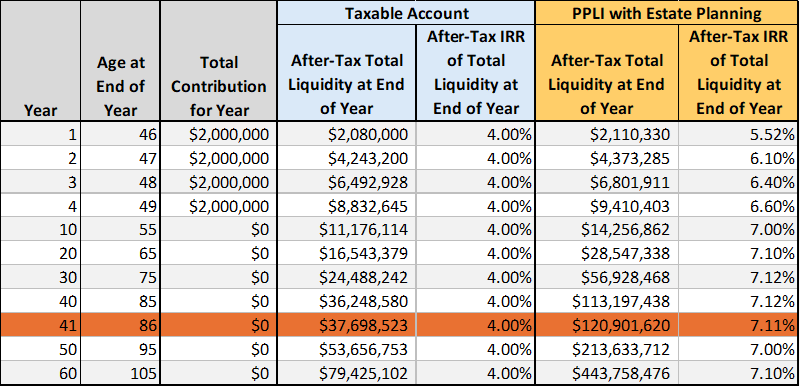
Investing in 100% bond portfolio via PPLI instead of a taxable account results in 221% more wealth at life expectancy (41 years).
Choosing to invest the $8M only the most tax-inefficient part of the portfolio within a PPLI vehicle maximizes the value of the PPLI vehicle. By the time the investor reaches their life expectancy in 41 years (at age 86), the PPLI vehicle has added over $83M of after-tax value over investing this part of the portfolio in a taxable account ($120.9 million versus $37.7 million).
Ultimately this amounts to a 7.11% after-tax IRR at life expectancy when the client invests this part of the portfolio via PPLI as opposed to a 4.00% after-tax IRR at life expectancy if the client were to invest in that same part of the portfolio via a taxable account.
This is a gain of over 300 basis points.
Conclusion
This case study highlights the substantial advantages of Private Placement Life Insurance (PPLI) over taxable accounts, particularly for high-net-worth individuals and the tax-inefficient parts of their portfolio (hedge funds, alternative assets, private credit, etc). The more tax-inefficient the asset is, the more value PPLI can have for the client as an investing vehicle.
The key benefit of PPLI is its tax-free feature, which allows for greater compounding of returns over time, driving enhanced wealth accumulation. Additionally, PPLI offers estate tax protection and a robust death benefit, making it an attractive option for long-term investors focused on wealth preservation and transfer.
Rajiv Rebello
Author
Rajiv Rebello, FSA, CERA is the Principal and Chief Actuary of Colva Insurance Services. Colva helps family offices, RIAs, and high net worth individuals create better after-tax and risk-adjusted portfolio solutions through the use of life insurance vehicles and low-correlation alternative assets. He can be reached at [email protected].
Determining the right death benefit level for your Private Placement Life Insurance (PPLI) policy is one of the most critical decisions that will impact your policy’s performance, costs, and overall effectiveness. This comprehensive guide explores how to balance regulatory requirements, estate planning needs, family protection goals, and investment capacity optimization to find the optimal death benefit level for your unique circumstances.
Hedge Fund Investments in PPLI: Benefits, Risks, and Due Diligence for Private Placement Life Insurance Strategies
Private placement life insurance (PPLI) has become an increasingly popular vehicle for high-net-worth individuals seeking to combine life insurance benefits with alternative investment strategies. Among the various investment options available within PPLI structures, hedge fund investments offer unique opportunities for portfolio diversification and enhanced returns. Understanding the benefits, risks, and due diligence requirements of hedge fund investments in private placement life insurance is essential for making informed decisions about this wealth management strategy.
## Understanding Hedge Fund Integration in PPLI Structures
Hedge fund investments within PPLI policies operate through carefully structured arrangements that maintain the insurance wrapper’s tax advantages while providing access to alternative investment strategies. These investments typically occur through dedicated funds or separately managed accounts designed specifically for insurance company separate accounts, ensuring compliance with regulatory requirements governing private placement life insurance.
The structure allows policyholders to access hedge fund strategies that might otherwise be unavailable or less tax-efficient in direct investment formats. Insurance companies work with established hedge fund managers to create insurance-dedicated versions of their strategies, often with modified fee structures and enhanced liquidity provisions tailored to the insurance environment.
PPLI hedge fund investments can encompass various strategies including long-short equity, event-driven approaches, relative value strategies, and macro trading. The insurance wrapper provides a tax-deferred growth environment where hedge fund returns can compound without immediate tax consequences, potentially enhancing long-term wealth accumulation compared to direct hedge fund investments.
## Tax Advantages and Wealth Preservation Benefits
The primary benefit of hedge fund investments within PPLI lies in the tax treatment of returns generated by these strategies. Traditional hedge fund investments typically generate significant taxable income through short-term capital gains, dividend income, and interest income, all of which are taxed at ordinary income rates. Within the PPLI structure, these returns accumulate tax-deferred, allowing for more efficient compound growth over time.
Estate planning benefits represent another significant advantage of hedge fund PPLI investments. The death benefit proceeds pass to beneficiaries income tax-free, effectively transferring hedge fund returns without the tax burden that would apply to direct hedge fund investments. This feature proves particularly valuable for families seeking to transfer wealth generated by alternative investment strategies to future generations.
The ability to access policy values through loans without triggering taxable events provides additional flexibility compared to direct hedge fund investments. Policyholders can access liquidity based on their hedge fund investment performance without the immediate tax consequences associated with hedge fund withdrawals or redemptions.
## Enhanced Diversification and Return Potential
Hedge fund strategies within PPLI offer portfolio diversification benefits that extend beyond traditional stock and bond investments. Market-neutral strategies, for example, can provide returns with low correlation to equity markets, helping to reduce overall portfolio volatility while maintaining growth potential.
Alternative risk premia strategies accessible through PPLI hedge fund investments can capture returns from various market inefficiencies and behavioral biases. These strategies often provide steady returns with different risk characteristics than traditional investments, contributing to more balanced portfolio performance across various market conditions.
The ability to combine multiple hedge fund strategies within a single PPLI policy creates opportunities for further diversification. Policyholders can allocate among different hedge fund managers and strategies, creating a fund-of-funds approach within the insurance wrapper while maintaining the tax benefits of the PPLI structure.
## Liquidity Considerations and Management
Hedge fund investments traditionally involve lock-up periods and limited redemption windows that can restrict investor access to capital. PPLI structures often negotiate enhanced liquidity provisions with hedge fund managers, including shorter lock-up periods, more frequent redemption opportunities, or side-pocket arrangements for illiquid investments.
Policy loan features provide additional liquidity options that bypass traditional hedge fund redemption restrictions. Policyholders can borrow against their policy values, including those supported by hedge fund investments, without triggering hedge fund redemptions or violating lock-up provisions.
The insurance company’s role in managing hedge fund redemptions within PPLI policies helps coordinate liquidity needs across multiple policyholders. This pooling effect can sometimes provide better redemption terms than individual investors might achieve in direct hedge fund investments.
## Risk Assessment and Management Strategies
Hedge fund investments within PPLI carry specific risks that require careful evaluation and ongoing monitoring. Manager risk represents a primary concern, as hedge fund strategies often depend heavily on the skill and discipline of individual portfolio managers. Due diligence must focus on manager track records, investment processes, and risk management capabilities.
Operational risk assessment becomes critical when evaluating hedge fund managers for PPLI investments. The insurance wrapper adds additional operational complexity, requiring hedge fund managers to maintain proper reporting, compliance, and administrative capabilities to support insurance company requirements.
Concentration risk can emerge when PPLI policies become heavily weighted toward hedge fund investments or specific hedge fund strategies. Diversification across multiple managers, strategies, and asset classes helps mitigate this risk while maintaining the benefits of alternative investment exposure.
## Due Diligence Framework for Hedge Fund Selection
Effective due diligence for hedge fund investments in PPLI requires analysis of both investment merits and insurance-specific considerations. Investment due diligence should evaluate the hedge fund manager’s investment philosophy, process consistency, and historical performance across different market cycles.
Operational due diligence must assess the hedge fund manager’s ability to operate within the insurance environment, including reporting capabilities, compliance infrastructure, and experience with insurance company separate accounts. The manager’s willingness to modify fee structures or provide enhanced liquidity for insurance applications represents important considerations.
Third-party due diligence resources, including hedge fund research platforms and specialized consultants, can provide valuable insights into manager capabilities and operational strengths. Insurance companies often maintain preferred manager lists based on their own due diligence processes, providing additional filtering for PPLI hedge fund investments.
## Fee Structure Analysis and Cost Management
Hedge fund investments within PPLI typically involve multiple fee layers that require careful analysis to understand total investment costs. Management fees and performance fees charged by hedge fund managers represent the primary investment costs, often following traditional “2 and 20” structures or variations thereof.
Insurance company charges add additional costs to hedge fund PPLI investments, including mortality and expense charges, administrative fees, and surrender charges. Understanding the interaction between hedge fund fees and insurance charges helps evaluate the total cost of accessing hedge fund strategies through PPLI.
Fee negotiations for hedge fund investments in PPLI sometimes result in reduced costs compared to direct hedge fund investments. The pooled nature of insurance company separate accounts and long-term investment horizons can provide leverage for better fee arrangements with hedge fund managers.
## Performance Monitoring and Reporting
Hedge fund investments within PPLI require specialized monitoring and reporting capabilities to track performance and ensure alignment with investment objectives. Monthly performance reporting should include both gross and net returns, attribution analysis, and risk metrics specific to the hedge fund strategy employed.
Benchmark comparisons become important for evaluating hedge fund performance within PPLI, though appropriate benchmarks vary by strategy type. Hedge fund indices, peer group comparisons, and risk-adjusted performance measures help assess whether hedge fund investments are delivering expected value within the insurance wrapper.
Regular portfolio reviews should evaluate the ongoing suitability of hedge fund investments within the broader PPLI policy structure. Changes in market conditions, investment objectives, or hedge fund manager capabilities may necessitate adjustments to hedge fund allocations or manager selections.
## Regulatory Compliance and Reporting Requirements
Hedge fund investments within PPLI must comply with various regulatory requirements governing both insurance products and alternative investments. Investor control restrictions ensure that policyholders maintain appropriate distance from investment decisions to preserve favorable tax treatment under private placement life insurance regulations.
Anti-money laundering and know-your-customer requirements apply to hedge fund investments within PPLI, requiring proper documentation and ongoing monitoring of beneficial ownership and source of funds. These requirements may be more stringent than direct hedge fund investments due to the insurance wrapper.
Tax reporting for hedge fund investments within PPLI occurs at the insurance company level, simplifying tax compliance for policyholders while maintaining transparency regarding underlying investment performance and tax characteristics.
## Integration with Overall Wealth Management Strategy
Hedge fund investments within PPLI should align with broader wealth management and estate planning objectives rather than serving as isolated investment decisions. The insurance death benefit, tax deferral features, and liquidity options must work together to support overall financial goals.
Coordination with other investment accounts helps optimize asset location and tax efficiency across the entire investment portfolio. Hedge fund strategies within PPLI may complement traditional investments held in taxable accounts or retirement plans, providing diversification benefits while maximizing tax efficiency.
Regular strategy reviews ensure that hedge fund investments within PPLI continue to serve their intended purpose as circumstances change. Market conditions, tax law modifications, or personal financial situations may affect the optimal allocation to hedge fund strategies within the insurance wrapper.
## Future Considerations and Market Developments
The hedge fund industry continues to develop new strategies and approaches that may become available within PPLI structures. Emerging areas such as digital assets, ESG-focused strategies, and quantitative approaches may offer additional opportunities for PPLI hedge fund investments.
Regulatory developments affecting either hedge funds or private placement life insurance may impact the attractiveness or structure of these investments. Staying informed about regulatory changes helps ensure continued compliance and optimal strategy implementation.
Technology improvements in hedge fund operations and insurance administration may enhance the efficiency and cost-effectiveness of hedge fund investments within PPLI. These developments could expand access to hedge fund strategies or improve the overall economics of combining hedge funds with insurance wrappers.
Hedge fund investments within private placement life insurance represent a powerful tool for wealth accumulation and estate planning when properly implemented and managed. The combination of tax advantages, diversification benefits, and professional management creates opportunities for enhanced long-term wealth creation. However, success requires careful due diligence, ongoing monitoring, and integration with broader wealth management strategies. By understanding the benefits, risks, and requirements of hedge fund PPLI investments, high-net-worth individuals can make informed decisions about incorporating these strategies into their overall financial plans.
0 Comments