The Problem with Having a Large Amount in Your Traditional IRA

Rajiv Rebello
Author
July 03, 2025

Author

Traditional Individual Retirement Accounts (IRAs) have long been heralded as cornerstone retirement savings vehicles, offering immediate tax deductions and decades of tax-deferred growth. However, as these accounts grow substantially over time, they can transform from wealth-building assets into significant tax burdens that impact both retirees and their beneficiaries. Understanding the hidden costs of large traditional IRA balances reveals critical planning opportunities that many investors overlook until it’s too late.
Beginning at age 73, traditional IRA owners face mandatory Required Minimum Distributions (RMDs) that force withdrawals whether needed or not. These distributions are calculated as a percentage of your account balance, starting at approximately 3.8% and increasing each year as life expectancy factors decrease. The larger your traditional IRA balance, the more devastating this tax obligation becomes.
Consider a retiree with a $2 million traditional IRA at age 73. Their first RMD would require withdrawing approximately $75,188, all of which gets taxed as ordinary income. If this retiree files jointly and has other income sources totaling $50,000 annually, their total taxable income jumps to $125,188, pushing them into the 22% federal tax bracket and potentially triggering additional taxes on Social Security benefits.
The tax bill on this RMD alone would exceed $16,500 in federal taxes, not including state income taxes. As the account holder ages, RMD percentages increase while account balances may continue growing, creating an escalating tax burden that can consume increasingly larger portions of retirement savings.
Large traditional IRAs often continue growing even during the RMD years, making the tax problem progressively worse. Consider an even more concerning scenario: an 80-year-old with a $3 million traditional IRA faces an RMD of approximately $162,600. Combined with $60,000 in other retirement income, this creates a taxable income of $222,600.
At these income levels, the retiree faces not only higher marginal tax rates but also additional penalties. The 22% federal tax bracket applies to most of this income, generating federal taxes exceeding $35,000 annually just on the RMD portion. State taxes in high-tax states could add another $10,000 or more, meaning nearly 30% of the required withdrawal disappears to taxes.
This example demonstrates how large traditional IRA balances create a forced tax acceleration that retirees cannot control, often pushing them into higher tax brackets than they experienced during their working years.
The SECURE Act of 2019 eliminated the “stretch IRA” provision for most non-spouse beneficiaries, requiring complete distribution of inherited traditional IRAs within 10 years. This change amplifies the tax problems associated with large traditional IRA balances by compressing what could have been decades of distributions into a single decade.
Consider adult children who inherit a $2 million traditional IRA. Under the 10-year rule, they must withdraw the entire balance by the end of the tenth year following the original owner’s death. If distributed evenly, this creates $200,000 in additional taxable income annually for each beneficiary.
For beneficiaries in their peak earning years, this additional income often pushes them into the highest tax brackets. A beneficiary earning $150,000 annually who receives $200,000 from an inherited IRA faces taxation on $350,000 total income, placing most of the inheritance in the 32% or even 35% federal tax bracket. The inherited IRA that was worth $2 million could lose $600,000 or more to taxes, leaving beneficiaries with significantly less than the account’s apparent value.
The current federal deficit exceeding $31 trillion creates substantial pressure for future tax increases. Historical tax rates provide perspective on this risk—the current top marginal rate of 37% remains well below the 50% rates common in the 1980s and the 70%+ rates of the 1970s.
Many economists and policy experts predict significant tax increases within the next decade as the government seeks revenue to address mounting debt obligations and aging population costs. Large traditional IRA balances become increasingly problematic as tax rates rise, since every dollar withdrawn faces higher taxation.
A retiree with substantial traditional IRA assets effectively has a “tax partner” in their retirement savings—the government. As tax rates increase, this partner’s share grows larger, leaving account holders with less purchasing power from their accumulated savings.
One effective strategy involves strategically withdrawing traditional IRA funds during lower-income years before RMDs begin. This approach works particularly well for retirees in their early 60s who have retired but haven’t yet claimed Social Security benefits, creating a window of potentially lower taxable income.
For example, a 62-year-old couple with $1.5 million in traditional IRAs and minimal other income could withdraw $50,000 annually from their traditional accounts. Filing jointly with the standard deduction, this withdrawal would face approximately 12% federal taxation, resulting in roughly $6,000 in federal taxes.
By strategically managing these early withdrawals to stay within the 12% tax bracket, this couple could remove $500,000 from their traditional IRA over 10 years while paying relatively low tax rates. This reduces their eventual RMD burden and preserves more wealth for beneficiaries.
Ready to optimize your traditional IRA withdrawals?
Book a CallRoth conversions offer another powerful tool for managing large traditional IRA balances. By converting traditional IRA assets to Roth IRAs, account holders pay taxes on the converted amount now but eliminate future RMDs and create tax-free growth for beneficiaries.
Consider a 55-year-old with a $1 million traditional IRA who converts $100,000 annually over 10 years. Assuming they’re in the 22% tax bracket, each conversion generates $22,000 in taxes but moves $100,000 into a tax-free Roth environment.
After 20 years of growth at 6% annually, the converted funds could be worth approximately $3.2 million in Roth assets—completely tax-free for withdrawals and inheritance. The total tax cost of roughly $220,000 for the conversions pales in comparison to the taxes avoided on this larger balance.
Roth conversions become even more attractive when considering the 10-year distribution rule for beneficiaries. Inherited Roth IRAs also face the 10-year requirement, but distributions remain tax-free, providing substantial advantages over inherited traditional IRAs.
Considering Roth conversions?
Book a CallSuccessful traditional IRA tax management requires careful attention to tax bracket optimization. The key lies in filling up lower tax brackets with strategic withdrawals or conversions without pushing income into unnecessarily higher brackets.
For 2024, married couples filing jointly can have taxable income up to $89,450 while staying in the 12% bracket, and up to $190,750 while remaining in the 22% bracket. Strategic planners use these thresholds to determine optimal withdrawal and conversion amounts.
A couple with significant traditional IRA balances might target withdrawals that bring their total taxable income to exactly the top of the 12% bracket, maximizing the tax-efficient removal of funds. This approach requires coordination with other income sources, including Social Security timing, pension distributions, and investment income.
Managing large traditional IRA balances requires sophisticated tax planning that considers multiple variables including current income, future tax rate projections, Social Security optimization, Medicare premium impacts, and estate planning objectives. Professional guidance becomes essential for developing and implementing strategies that minimize lifetime tax costs.
Tax planning software and projections help model various scenarios, showing the long-term impact of different withdrawal and conversion strategies. These tools can demonstrate how current decisions affect future tax burdens and help identify optimal timing for various planning moves.
For charitably inclined individuals aged 70½ and older, Qualified Charitable Distributions offer a powerful way to satisfy RMDs while avoiding taxation entirely. QCDs allow direct transfers from traditional IRAs to qualified charities, up to $100,000 annually per person ($200,000 for married couples).
A 75-year-old with a $1.5 million traditional IRA facing a $65,000 RMD could donate $65,000 directly to charity through a QCD. This satisfies the entire RMD requirement without generating any taxable income, effectively providing a 100% tax deduction for the charitable gift. For someone in the 24% tax bracket, this saves approximately $15,600 in federal taxes annually compared to taking the RMD and making a separate charitable donation.
QCDs become particularly valuable for retirees who don’t itemize deductions, as they provide tax benefits for charitable giving that wouldn’t otherwise be available under the standard deduction.
Strategic withdrawal sequencing from different account types can significantly reduce lifetime tax costs. Rather than withdrawing proportionally from all accounts, retirees can optimize their tax situation by carefully choosing which accounts to tap first.
A common strategy involves spending taxable accounts first (which have favorable capital gains rates), then Roth accounts (if needed for income), and traditional tax-deferred accounts last. However, with large traditional IRA balances, this sequence may need modification to include strategic traditional IRA withdrawals during lower-income years.
For example, a retiree with $500,000 in taxable accounts, $300,000 in Roth IRAs, and $2 million in traditional IRAs might benefit from taking some traditional IRA distributions early to avoid massive RMDs later, even while still spending down taxable accounts.
For wealthy individuals concerned about estate taxes and beneficiary tax burdens, using traditional IRA distributions to fund life insurance can provide significant advantages. This strategy involves taking larger distributions from traditional IRAs during lower tax rate years and using the after-tax proceeds to purchase life insurance.
Consider a 60-year-old in the 22% tax bracket with a $3 million traditional IRA. They could withdraw $200,000 annually, pay $44,000 in taxes, and use the remaining $156,000 to fund a permanent life insurance policy. Over time, this creates a tax-free death benefit that could exceed the original traditional IRA value while removing assets from the taxable estate.
This approach works particularly well when current tax brackets are lower than expected future rates, as it locks in today’s tax costs while creating tax-free wealth transfer opportunities.
For individuals planning significant future charitable giving, funding donor-advised funds with traditional IRA distributions during lower tax bracket years can provide immediate tax benefits while preserving charitable flexibility.
A retiree could take additional traditional IRA distributions during early retirement years when in the 12% bracket, donate the funds to a donor-advised fund for immediate tax deductions, then distribute the funds to charities over time. This strategy provides immediate tax relief on traditional IRA distributions while building a charitable legacy.
While individual planning strategies can help mitigate the problems with large traditional IRAs, several government policy changes could provide broader relief for retirees facing these tax burdens.
Congress could continue raising the RMD age beyond the current 73, giving retirees more time to implement tax-efficient strategies. Raising the RMD age to 75 or 80 would provide additional years for Roth conversions during potentially lower tax brackets and allow more time for charitable giving strategies.
The current $100,000 annual limit for Qualified Charitable Distributions hasn’t been adjusted for inflation since its inception. Increasing this limit to $150,000 or $200,000, or indexing it to inflation, would provide more tax relief for charitably inclined retirees with large traditional IRA balances.
Congress could consider modifications to the SECURE Act’s 10-year distribution requirement, such as allowing stretch distributions for smaller inherited accounts or providing tax rate smoothing for large inherited balances. Alternative approaches might include allowing beneficiaries to spread inherited IRA income over a longer period or providing special tax rates for inherited retirement accounts.
The government could implement preferential tax rates for RMD distributions, similar to capital gains rates, recognizing that these are forced distributions rather than voluntary withdrawals. This would help reduce the tax burden on retirees who don’t need the income but are forced to take distributions.
A policy allowing retirees to convert their RMD amounts directly to Roth IRAs (rather than taking distributions) could provide more flexibility. This would satisfy the distribution requirement while allowing continued tax-deferred growth in a Roth format.
While these potential government solutions could provide significant relief, retirees cannot rely on future policy changes and should focus on strategies available under current law. However, advocating for these types of reforms through professional organizations and elected representatives could help bring about beneficial changes for future retirees.
Business owners or those considering business ventures might use traditional IRA distributions to fund business investments that generate tax benefits or create opportunities for income shifting to family members in lower tax brackets.
Traditional IRA distributions could fund family business investments that employ children or grandchildren, effectively shifting future income to family members in lower tax brackets while removing money from high-tax traditional accounts.
The problems associated with large traditional IRA balances are entirely predictable but require proactive planning to address effectively. Waiting until RMDs begin severely limits available strategies and often locks account holders into suboptimal tax outcomes.
Retirees and pre-retirees with substantial traditional IRA balances should begin planning immediately to avoid the tax traps that await. Whether through strategic early withdrawals, systematic Roth conversions, or combination approaches, opportunities exist to significantly reduce lifetime tax costs and preserve more wealth for intended beneficiaries.
The key insight is that traditional IRAs represent tax-deferred, not tax-free, savings. The larger these accounts grow, the larger the eventual tax bill becomes. With proper planning and strategic action, however, account holders can take control of this tax obligation and minimize its impact on their retirement security and legacy wealth transfer goals.
The time to act is now, while tax rates remain historically reasonable and planning opportunities still exist. Large traditional IRA balances will only become more problematic as tax rates rise and account values continue growing. Proactive planning today can save hundreds of thousands in taxes tomorrow.
Don’t wait until it’s too late. Contact us to assist you with your personalized traditional IRA optimization strategy and start saving on taxes immediately.
Book a CallAuthor
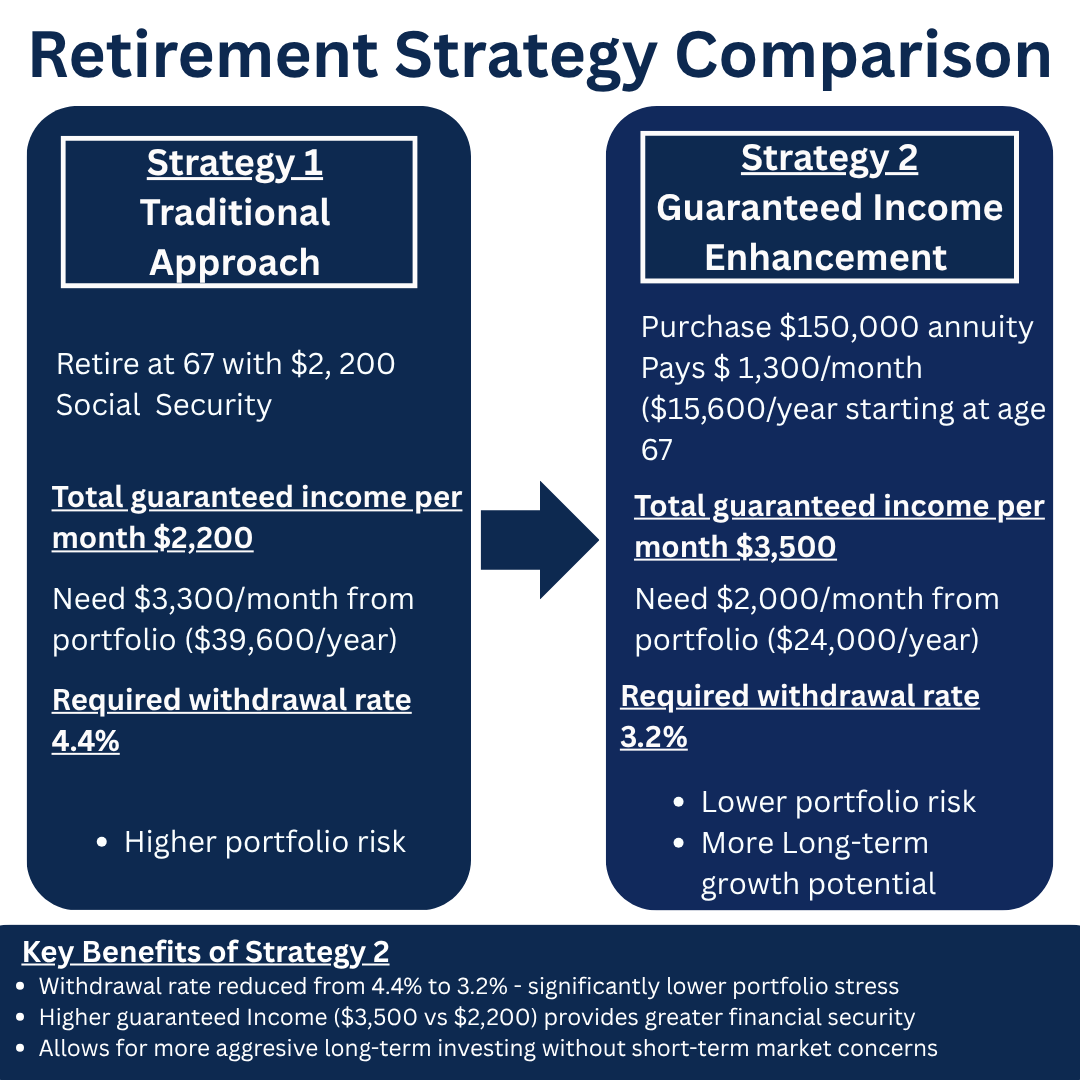
Discover how guaranteed lifetime income annuities can reduce your portfolio withdrawal rate from 4.4% to 3.2%, providing greater financial security and allowing for more aggressive long-term investing in retirement.

Introduction to PPLI Asset Protection Private Placement Life Insurance (PPLI) has emerged as a valuable strategy for individuals seeking both wealth preservation and asset protection. As financial markets fluctuate and liability concerns grow, PPLI offers a unique...

7. Explore premium financing strategies for PPLI to maximize wealth creation through leverage. Learn how private placement life insurance financing can multiply estate values while minimizing personal capital outlay
0 Comments