The Retirement Tax Break That Could Save You Thousands: 0% Capital Gains Tax Rate Up to $146,400

Rajiv Rebello
Author
March 02, 2026

Author

Most people don’t realize that when they retire they have a great opportunity to sell parts of their investment portfolio and pay 0% federal capital gains up to $146,400.
While you’re working you typically are in a high tax bracket. This means that you would normally pay anywhere from 15% to 23.8% in federal taxes on your capital gains. On top of that, if you live in states like California you will pay state taxes on top of this. This state tax rate can be as high as 14.4%.
That means your total capital gains tax rate if you live in California can be as high as 38.2% (23.8% federal + 14.4% state tax).
However with smart planning, you can pay a 0% federal tax rate on this income as long as you are below the threshold ($146,400 for married couples in 2026).
You can do this for a number of years after you retire, but before you start taking Social Security — which you will have to pay federal taxes on.
Let’s take a look at how to do this.
Here’s the magic number for 2026: if your total taxable income (including your capital gains) is $146,400 or less and you’re married filing jointly (both age 65+), or $73,200 or less if you’re single, you could pay absolutely nothing in federal capital gains taxes.
But how is that possible? Four deductions and exemptions stack together to make it happen.
Let’s look at a married couple, both age 65+, with the following income:
Ordinary Income: $47,500
LTCG Income: $98,900
Adjusted Gross Income (AGI): $146,400
Here’s how the math works:
The combined deductions completely wipe out the $47,500 in ordinary income. Taxable ordinary income: $0.
Adding all these up — $32,200 + $3,300 + $12,000 + $98,900 — we get $146,400. That’s the magic number that brings your federal tax bill to zero.
Let’s put this in perspective with some real-world examples:
Sarah, the Teacher: She’s single in California and earns $45,000 annually as a high school teacher. Sarah bought Apple stock for $5,000 years ago that is now worth $20,000. Sarah decides to sell the stock and realize a $15,000 long-term capital gain. So her total taxable income for the year is $60,000 ($45,000 teacher salary plus $15,000 long-term capital gain).
Sarah will still pay ordinary income taxes on the $45,000 and a small amount of state taxes on the $15,000 capital gain. But she will pay no federal taxes on the $15,000 stock gain since her total income is only $60,000 ($45,000 teacher salary plus $15,000 long-term capital gain from stock sale) which is less than the $73,200 threshold for single individuals.
Taxable Income | Stock Gain Part of Income | Income Taxes Owned on Stock Gain |
|---|---|---|
| $60,000 | $15,000 | $0 |
Since Sarah’s total taxable income for the year is less than $73,200, Sarah will pay no Federal taxes on her $15,000 stock gain. |
Melissa and Jaime: Melissa currently makes $250,000 a year while Jaime is retired. Melissa is thinking about retiring at the end of this year. They bought stock of Netflix 5 years ago for $10,000. The stock is currently worth $110,000. This means there would be a $100,000 gain. Melissa and Jaime want to sell the stock but are debating whether to do it this year or next year after Melissa retires and has no income.
The table below shows the effects if Melissa and Jaime sell the stock this year versus next year.
Taxable Income | Stock Gain | Income Taxes Owned on Stock Gain | Income Taxes Owed on Stock Gain | Taxes Due to Stock Gain | |
| Sell While Working | $350,000 | $100,000 | ($23,800) | ($9,000) | ($33,100) |
| Sell in Retirement With No Other Income | $100,000 | $100,000 | $0 | ($2,531) | ($2,531) |
By waiting until Melissa retires and they have no other income, Melissa and Jaime can reduce the taxes they pay on their stock gain from $33,100 to $2,531. |
In the above table we see that Melissa and Jaime can save almost $31,000 in both Federal and State Taxes ($33,100 while working versus $2,531 in retirement) by selling the stock after Melissa retires and they have no other income.
The 0% capital gains rate isn’t just for low earners. Here are the 2026 thresholds where you pay absolutely nothing:
Before you start celebrating, there are a few important rules to remember:
This 0% rate only applies to long-term capital gains – investments you’ve held for more than a year. Sell too early, and those gains get taxed as ordinary income at much higher rates.
The key phrase here is “total taxable income.” This includes your salary, any other investment gains, and the capital gains you’re calculating. So if you’re already at the income threshold, even a small gain could push you into the 15% bracket.
Those dividend payments from your stocks? If they’re “qualified dividends” (which most are from large U.S. companies), they also get this preferential treatment and the same 0% rate.
If you’re near the income threshold, consider spreading large gains across multiple tax years. Instead of selling everything in December, sell half in December and half in January.
Example: Let’s say you’re single with a $65,000 salary and have $15,000 in gains to realize. Selling it all at once puts you at $80,000 – above the $73,200 threshold. But sell $8,200 this year and $6,800 next year, and you stay in the 0% bracket both times.
If you have losing investments, selling them can offset some gains and help keep you in the 0% bracket. This strategy, called tax-loss harvesting, lets you realize losses to reduce your taxable gains.
Taking a sabbatical? Between jobs? Getting married and filing jointly for the first time? These might be perfect years to realize some gains while your income is temporarily lower or your filing status gives you a higher threshold.
For married couples, remember that it’s your combined income that matters. If one spouse has a lower-earning year, that might be the perfect time to realize gains from either spouse’s accounts.
As we mentioned, in order to maximize the value of this 0% capital gains tax-rate, you want to minimize any other income you have. As such, it can make sense to delay claiming social security until after you have already used up the 0% capital gains tax-rate. For example, if I’m 65 and have $200,000 in unrealized capital gains. It might make sense to wait 2 years until taking social security so that I can sell my stock positions and realize $100,000 of gains in each year and pay 0% federal capital gains on it. Then I can start taking social security.
Jessica works full-time making $48,000 but also runs a small Etsy business that brings in another $12,000 annually. Her total income of $60,000 leaves her with $3,350 of “room” in the 0% bracket. When her index funds show a $3,000 gain after two years, she can sell without owing any capital gains tax.
Bob and Linda are both 58 and considering early retirement. Their combined income is $115,000, but they’re planning to dial back to part-time work next year, dropping their income to around $80,000. That’s the perfect year to realize some gains from their taxable investment accounts at 0%.
Alex is 28, makes $58,000 as a teacher, and inherited some stock from his grandmother three years ago. The stock has grown significantly, and he wants to sell $4,000 worth to pay off student loans. His total income of $62,000 keeps him just under the threshold for 0% treatment.
This isn’t just about saving money on taxes (though that’s nice). The 0% capital gains rate represents something bigger: the government’s recognition that building wealth through patient, long-term investing should be rewarded.
Unlike day trading or speculation, this benefit goes to people who buy quality investments and hold them. It’s designed to encourage the kind of investing behavior that actually builds lasting wealth – exactly what most Americans need to do more of.
Consider this: if you’re in the 22% tax bracket for ordinary income but qualify for 0% on capital gains, you’re essentially getting a 22-percentage-point advantage by investing in appreciating assets rather than keeping money in savings accounts or CDs.
Don’t panic if you exceed the thresholds – you don’t fall off a cliff. Above the 0% thresholds, you’ll pay 15% on long-term capital gains up to much higher income levels:
Only ultra-high earners (above those thresholds) pay the top 20% rate. So even if you exceed the 0% threshold, you’re still getting preferential treatment compared to ordinary income tax rates.
“This is only for rich people”
False. As we’ve seen, this benefit is specifically designed for middle-class investors. The wealthy are more likely to be in the 15% or 20% brackets.
“You need a lot of money to invest to make this worthwhile”
False. Even modest, consistent investing can lead to meaningful gains over time. Someone investing $200 monthly could easily have $5,000-$10,000 in gains after several years.
“It’s too complicated to figure out”
False. While tax planning can get complex, the basic concept is straightforward: if your total income (including gains) is under the threshold, you pay 0%.
If you’re not already investing, this could be the nudge you need to start.
If you’re already investing, take a look at your portfolio:
The 0% capital gains rate isn’t a loophole or a complex tax strategy reserved for the wealthy. It’s a straightforward benefit available to millions of middle-class Americans who are doing exactly what financial advisors recommend: investing regularly, being patient, and building wealth for the future.
Tax laws change, and there’s always political discussion about capital gains rates. However, the 0% rate for middle-income investors has enjoyed bipartisan support because it encourages saving and investing among working families – something both parties generally favor.
That said, it’s worth taking advantage of this opportunity while it’s available and as generous as it currently is. Tax benefits have a way of becoming less generous over time, not more.
Sometimes the best tax strategies are hiding in plain sight. The 0% capital gains rate might be one of them – a powerful wealth-building tool that’s available to far more Americans than most people realize.
Start investing, be patient, hold for more than a year, and watch your money grow. When it’s time to sell, you might be surprised to find Uncle Sam doesn’t want his usual cut.
Ready to Take Advantage of the 0% Capital Gains Rate?
Book a CallRemember: Tax situations are individual, and this information is for educational purposes. Consider consulting with a tax professional for advice specific to your situation, especially if you’re near the income thresholds or have complex investments.
Author
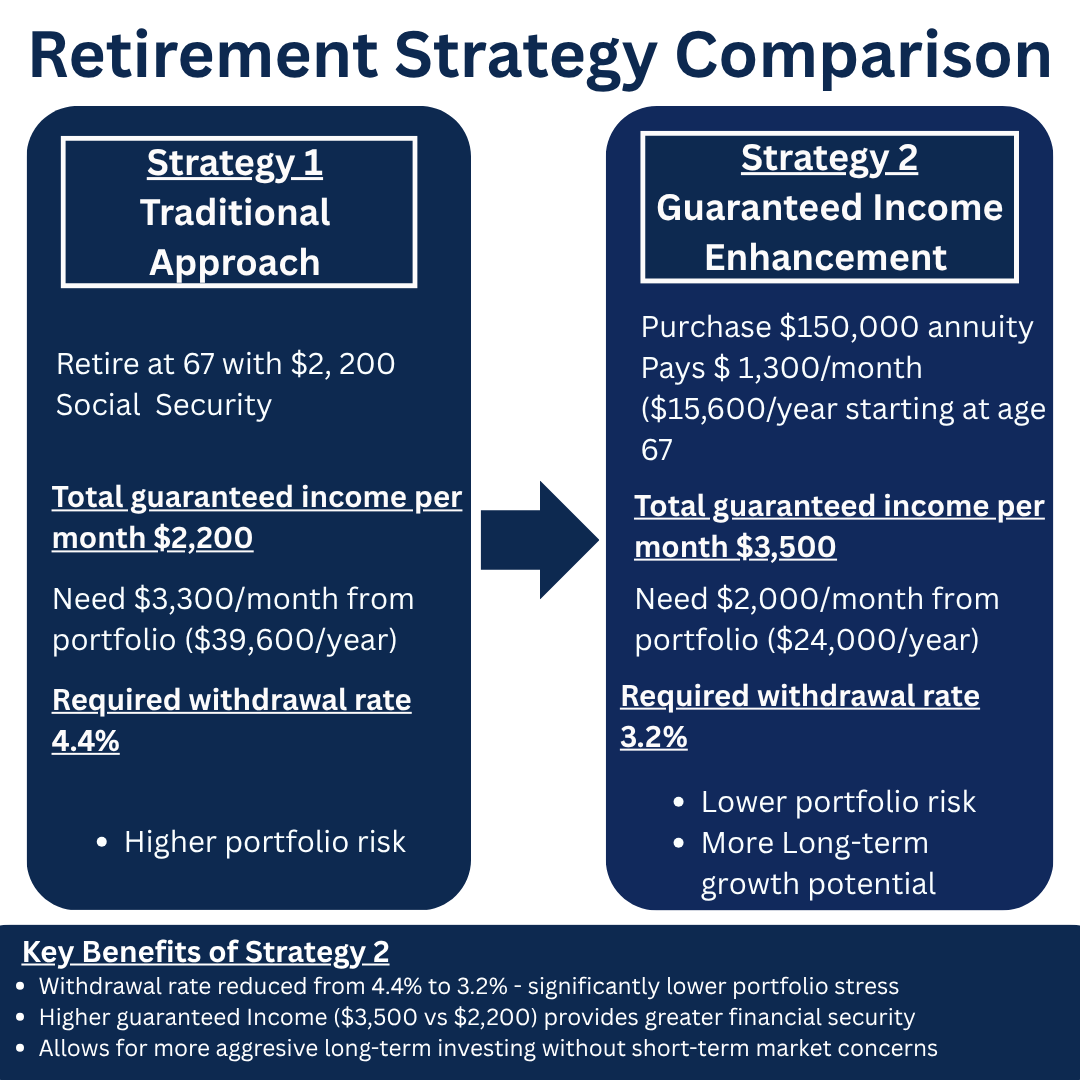
Discover how guaranteed lifetime income annuities can reduce your portfolio withdrawal rate from 4.4% to 3.2%, providing greater financial security and allowing for more aggressive long-term investing in retirement.

Introduction to PPLI Asset Protection Private Placement Life Insurance (PPLI) has emerged as a valuable strategy for individuals seeking both wealth preservation and asset protection. As financial markets fluctuate and liability concerns grow, PPLI offers a unique...

7. Explore premium financing strategies for PPLI to maximize wealth creation through leverage. Learn how private placement life insurance financing can multiply estate values while minimizing personal capital outlay
0 Comments